
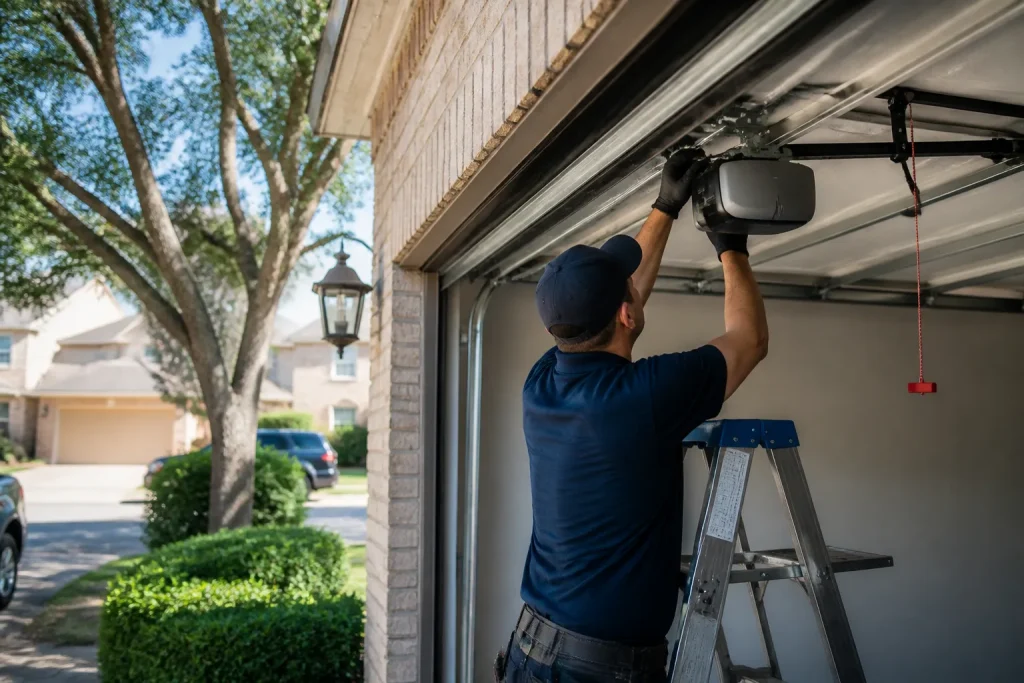
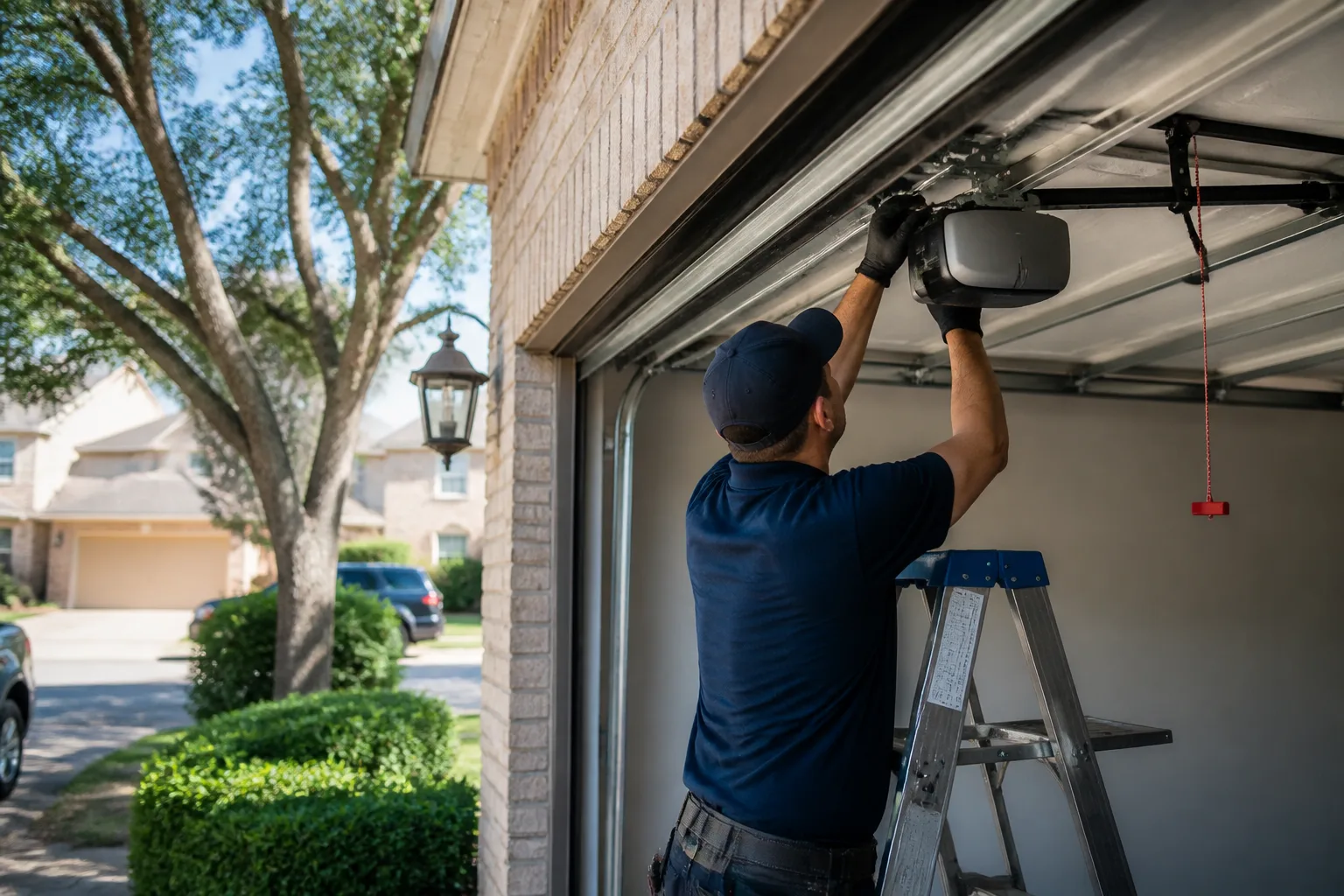
LiftMaster Garage Door Repair in Westchase: A Homeowner’s Guide
LiftMaster’s Error Code 4-2 triggers more service calls in the Houston area than almost any other opener fault, and it has nothing to do with the motor. Most homeowners, and plenty of generalists, replace the wrong part first. If you’d rather skip the guesswork and the liability, call us at (866) 690-3896 and we’ll diagnose it properly. Garage doors are all we do, and LiftMaster is a brand we know inside out.
What Does Error Code 4-2 Actually Mean on a LiftMaster Opener?
Error Code 4-2 on a LiftMaster opener usually means the safety sensors are misaligned, blocked, or seeing reflected light, not that the motor has failed. The code tells you the opener’s logic board stopped the door because it lost a clean signal from the photo-eye sensors at the base of the tracks. Before you replace anything, check whether the sensors are knocked out of alignment, whether a spider has built a web across the lens, or whether sunlight is hitting the receiving eye directly.
What catches people out is that 4-2 can also appear when a sensor wire has been nicked or worked loose over time. The symptom looks identical: the door starts down, reverses, and the light flashes. On Westchase doors, sun glare through a south-facing single-bay is a familiar culprit in the afternoon, and the fix is a repositioned sensor bracket, not a new opener. If the sensors are clean, aligned, and the LED indicators glow solid, the fault has moved upstream to the wiring or the logic board and needs a technician with a multimeter.
How Do LiftMaster Model Generations Fail Differently?
LiftMaster’s 8500W, 84501, and older 3800 series fail in different ways, which changes the repair-versus-replace decision. The 8500W is a wall-mounted jackshaft unit with no rail and no trolley, so its weak points are the wall-mount bracket, the torsion-bar collar, and the internal gearing rather than a belt or chain. The 84501 is a belt-drive ceiling unit where the belt tension and the drive gear typically wear out first. The 3800 series, now several generations old, shows up with tired logic boards and slipping drive gears more often than anything else.
Here’s how we think about it:
- 8500W: If the jackshaft mount has pulled loose or the collar has slipped, fix it. If the internal gearset is grinding, weigh a replacement.
- 84501: Belt and drive gear are routine wear items. Replace them and the unit usually runs another long stretch.
- 3800 series: A logic board on a unit that old can cost more than the value it restores. That’s the honest moment to talk replacement.
We stay current on the LiftMaster line specifically because the model number tells us where to look first. On Westchase doors, the age and generation of the opener matter more than the brand label on the housing.
MyQ Not Working? Connectivity Failures vs. Mechanical Failures
MyQ connectivity failures are not mechanical opener failures, even though the symptoms look the same from the driver’s seat. If the door opens and closes fine from the wall button but the app won’t connect, you have a network problem. If the door stops mid-travel or won’t respond at all, you have a mechanical or safety-system fault. Distinguishing the two saves you from paying for a repair you don’t need.
Start with the network side:
- Confirm your Wi-Fi router hasn’t changed channels or password recently.
- Check that the MyQ hub or Wi-Fi bridge has power and a solid indicator light.
- Re-run the in-app pairing process, which resolves most connectivity drops.
- If the opener is a legacy unit with a separate bridge, confirm the bridge didn’t get unplugged during a cleaning.
If those steps don’t restore the connection, or if the app shows the door but the door doesn’t actually move, the fault is in the opener’s logic board or radio module. We service the full LiftMaster smart-home line, so we can tell a dead radio from a dead board and quote you honestly. A Westchase homeowner with a modern LiftMaster should never accept “your app is broken” as an answer.
Why Does the Safety Reversal Trip So Often on Westchase Doors?
The safety reversal system trips more often on Westchase doors than on the national average because of two local factors: concrete floor settling and humidity-swollen seals. As a garage slab settles over the years, it can lift slightly at the door’s closing point, which changes the gap between the door bottom and the floor. The opener reads that change as an obstruction and reverses. Meanwhile, Houston humidity swells the rubber bottom seal until it drags or catches, which produces the same false reversal.
You can tell a floor-and-seal issue from a sensor fault by watching the door carefully. If it reverses only near the bottom of travel, suspect the seal or the floor gap. If it reverses immediately at the start, or the sensor light is off, suspect the photo-eye system. If the door reverses when nothing is in the way at all, the force sensitivity may be set too low.
Our technicians have up to 11 years of experience reading these symptoms on Westchase driveways, and we know that adjusting the reversal system is not a job to fudge. A door that reverses too easily is annoying; a door that doesn’t reverse when it should is a hazard. Prioritize the second and fix it right.
What Can You Fix Yourself, and What Should You Leave Alone?
Some LiftMaster tasks are genuinely DIY-safe, and others are not. Remote reprogramming, travel-limit adjustment, and force-sensitivity tuning are all within reach for a careful homeowner with the manual. The drive gear, logic board, and anything touching the spring system are technician work, full stop.
- DIY-safe: reprogramming a remote or keypad, clearing a logic-board error code, adjusting the travel limits so the door closes fully, and tuning force sensitivity to factory guidance.
- Technician-required: replacing a stripped drive gear, swapping a logic board, and any spring or cable work.
We want to be plain about that last line: springs are the most dangerous component in your garage door system, and this is not a DIY repair. A torsion spring under load can cause serious injury, which is why spring repair stays a standard service for us rather than something we hand off. If your LiftMaster door is straining against a tired spring, that’s a call, not a weekend project.
Related services in Westchase: garage door opener repair and garage door repair.
Counterfeit LiftMaster Parts: What to Check Before You Approve a Repair
Counterfeit LiftMaster logic boards and drive gears have entered the Houston market, and they’re the reason a repair can fail within months. Knockoff parts often look convincing, but they carry no genuine warranty and can damage the rest of the opener. Before you approve any repair, ask what part is going in and verify the source.
A few things to check:
- Ask whether the replacement part is OEM-compatible. The answer should be immediate, not a shrug.
- Look at the packaging for clean branding and a manufacturer part number that matches your unit.
- Ask what happens if the part fails. A reputable shop stands behind OEM-compatible parts.
We source OEM-compatible parts for LiftMaster, Chamberlain, and the other brands in our roster, and that’s what lets us get many repairs done in a single visit instead of a return trip. Whether you drive a LiftMaster, a Clopay door on the front, or a Wayne Dalton setup, the parts question matters. Also ask about the estimate itself: at Westchase Garage Door Repair, the price is quoted and agreed before any work starts, and the written estimate is the price. If your opener needs replacing rather than repairing, you can read more on our garage door installation page.
The Bottom Line
Most LiftMaster problems we see in Westchase come down to a short list: misplaced confidence in Error Code 4-2, model-specific wear points, MyQ confusion, humidity and settling tripping the reversal system, and counterfeit parts. Getting the diagnosis right the first time saves money, and staying away from spring work keeps you safe. If you’re in Westchase and need help, Westchase Garage Door Repair offers free estimates. Call (866) 690-3896. We answer 24/7, and we run fast dispatch from 7am to 7pm.
For the full scope of what we handle, start at Westchase Garage Door Repair. Eight brands, one specialist.
Frequently Asked Questions
Sometimes. Error Code 4-2 is a safety-sensor fault, so cleaning and realigning the sensors is a reasonable first step. If the sensors look clean and aligned and the code stays, the problem has moved to the wiring or the logic board, and that’s a technician call. Call (866) 690-3896 for a free estimate.
It depends on the fault. A worn drive gear or belt is worth repairing. A failed logic board on a 3800 series that old often costs more than the value it restores, which is the point to talk about replacement. We’ll tell you honestly which side of that line your unit falls on.
Test the door with the wall button. If it moves normally, your opener is fine and the issue is connectivity. If it doesn’t move, or stops partway, the fault is mechanical or in the safety system. Call (866) 690-3896 if you can’t tell the difference.
We stock and source OEM-compatible parts for LiftMaster, Chamberlain, Genie, Clopay, Amarr, Wayne Dalton, Craftsman, and Raynor systems. Ask about the part before you approve a repair, and check that the source is real. Call (866) 690-3896 for a free estimate and we’ll walk you through it.
Written by the team at Westchase Garage Door Repair.
Need Garage Door Help?
Call Westchase Garage Door Repair - the local pro we connect you with is licensed and insured, here with fast help in Westchase.
(866) 690-3896